
Capital Readiness for Data Center Infrastructure
Investor Grade Sustainability evidence - in weeks, not months
Most non -European data center developers discover their sustainability gap during live diligence when a Big 4 engagement takes 8 to 12 weeks and produces a narrative report their lenders ESG team still can't drop into a fund file.
If you are building or operating data centre infrastructure anywhere in the world — and need to access EU or UK capital, green loans, sustainability-linked facilities, or Article 8 or Article 9 fund mandates — this is the engagement that gets your project investor-ready.
Start with a free Capital Alignment Review - your gap analysis delivered in minutes. No charge. No credit card required.
EU Taxonomy 8.1, SFDR Art 8, SFDR Art 9, UK SDR, EU GBS, ICMA GBP
$530B
Green bonds forecast for 2026
$270B+
Global DC investment announced in 2025
Institutional investors now require sustainability compliance before capital is
committed — regardless of where your project sits
Most capital markets now operate under sustainability frameworks — the EU Taxonomy, SFDR, and UK SDR — that require verifiable, structured evidence of environmental performance before capital can be deployed. A data centre in Singapore, Lagos, Frankfurt, or Riyadh does not map onto these frameworks automatically. The performance may be there. The documentation almost never is.
The result is a transaction bottleneck that costs developers time, pricing leverage, and in some cases the deal itself. Sustainability gaps found during live lender diligence do not get fixed quickly. They get priced in, or they send the developer away to commission a months-long consultant engagement that costs six figures and produces a report that still is not in the right format.
Months of manual assessment
Traditional consultants take 8 to 12 weeks and charge £50K to £150K for compliance gap analysis that is outdated by the time it is delivered.
No location-specific tools
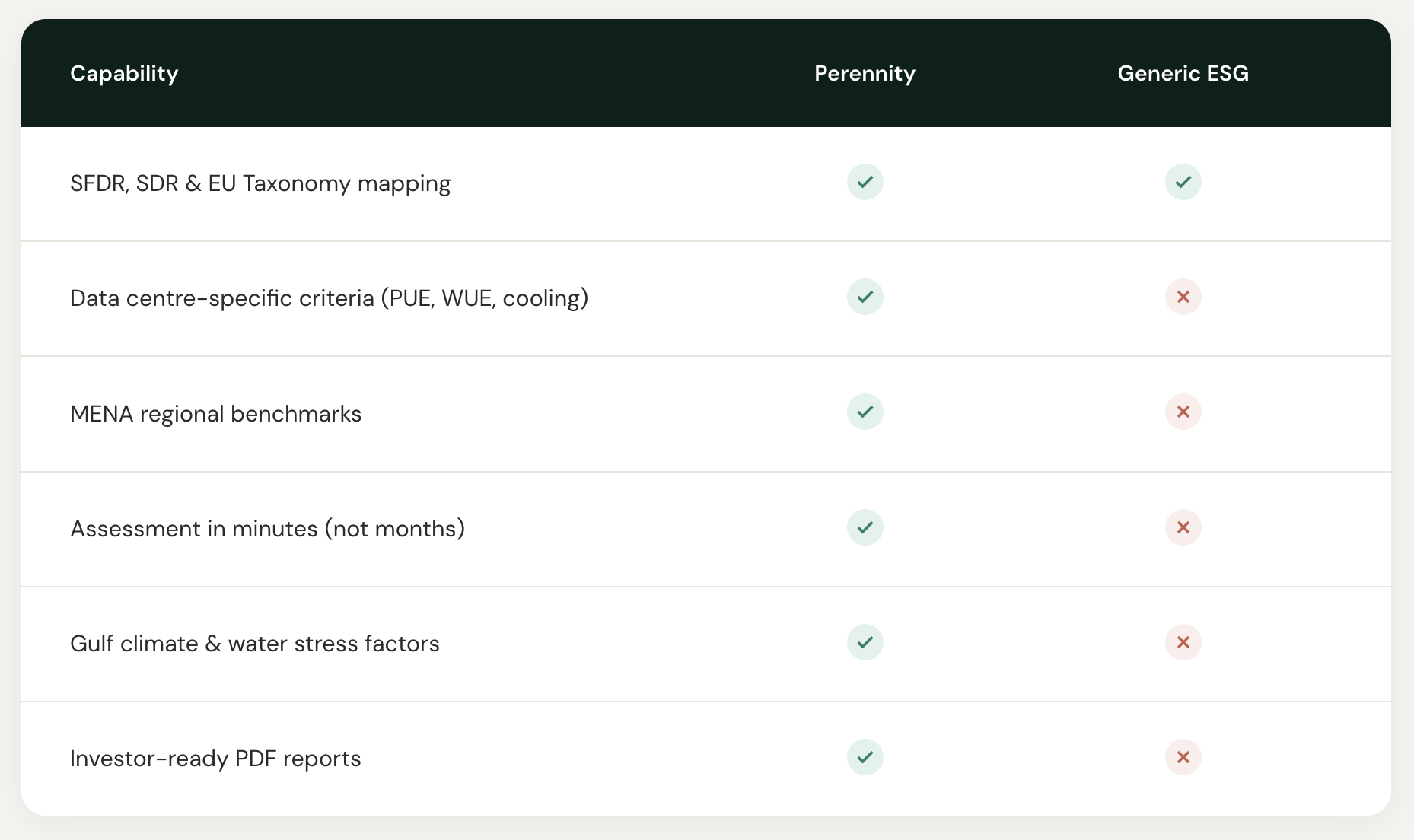
Generic ESG platforms do not account for local climate conditions, regional water stress classifications, or the carbon intensity of the grid your facility depends on.
Regulatory Complexity
SFDR Article 8/9, UK SDR labels, EU Taxonomy Activity 8.1 — investors expect you to know which applies to your project and why.
Not AI. Not Opinion. Auditable
The single hardest question an LP or credit committee will ask about a sustainability assessment is: "How was this scored?
Perennity Bridge gives one answer. Every threshold in the engine — every PUE band, every WUE calculation, every SFDR criterion verdict, every DNSH test — maps line-by-line to a published regulatory source. Regulation (EU) 2021/2139 Annex I for EU Taxonomy Activity 8.1. Commission Delegated Regulation (EU) 2022/1288 Annex I for SFDR Principal Adverse Impacts. FCA PS23/16 for the four UK SDR labels. ICMA Green Bond Principles and the EU Green Bond Standard for use-of-proceeds attestation.
The engine is rules-based, not machine-learning. There is no black-box model to defend, no probabilistic score for an external auditor to reject, and no analyst whose judgement you have to vouch for. The methodology is versioned, the version stamp ships in every PDF, and every claim in every report ties to a Source Evidence Log entry.
This is what makes the output defensible in front of a fund manager's ESG team, a DFI's compliance officer, or a rating-adjacent buyer. It is also what makes it auditable on the day a regulator asks.
From assessment to investor-ready in minutes
We take your project data — location, capacity, cooling design, energy sources, governance structure — and run it through a compliance assessment framework built for data centre infrastructure globally. We map your facility against EU Taxonomy Activity 8.1 Technical Screening Criteria, SFDR Article 8 and 9 eligibility requirements, UK SDR classification criteria, and applicable DFI standards, with regional calibration applied throughout for local climate conditions, water stress classifications, and grid carbon intensity.
Run the free assessment now and receive your gap analysis in minutes — a precise, project-specific picture of where your facility stands against EU and UK capital market requirements, and what needs to change.
Input your Datacenter metrics
Enter key metrics: PUE targets, renewable energy mix, water usage, cooling technology, and certifications.
~5 minutes
Get instant classification
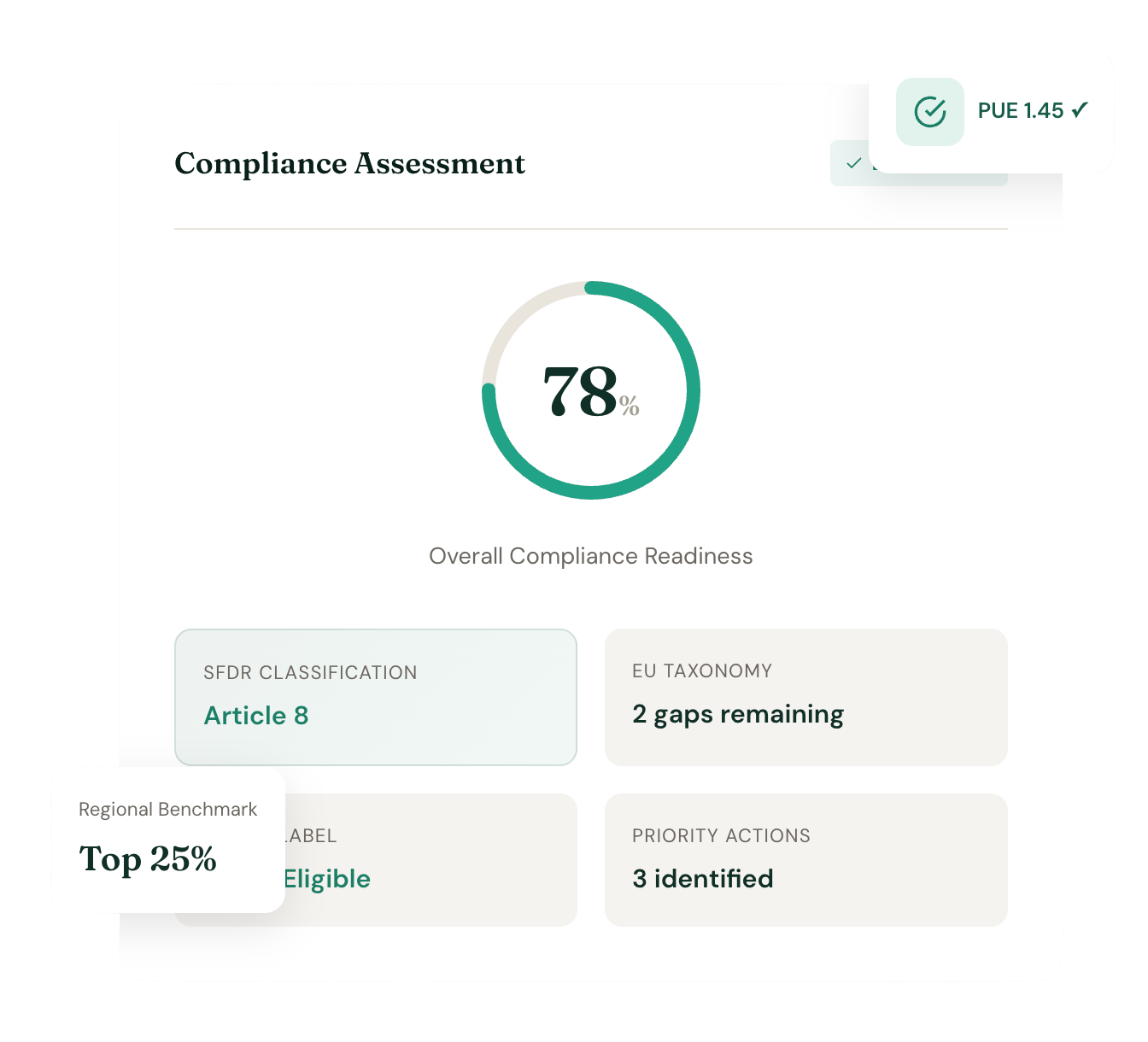
Receive your SFDR Article classification, UK SDR label eligibility, EU Taxonomy alignment status, and applicable DFI framework flags — with a full gap analysis.
Instant results
Download Snapshot
Capital Alignment Snapshot
Built for data centre developers raising international green capital
Developers planning or actively raising EU or UK capital for new data centre projects across any geography — from the Gulf and Africa to Southeast Asia, Europe, and the Americas.
Multi-Framework Mapping
A single assessment maps simultaneously to SFDR Article 6/8/9, all four UK SDR labels and EU Taxonomy Activity 8.1.
Investor-Ready Reports
Generate professional PDF reports designed for green finance due diligence, with executive summaries, technical appendices, and a citation trail to primary regulation.
Regulatory Intelligence
Stay current with automated tracking of SFDR, SDR, and EU Taxonomy updates — including the 2026 Taxonomy review cycle.
Global benchmarks
Compare your metrics against facilities across 35+ jurisdictions. See exactly where you stand on PUE, water efficiency, and renewable energy for your specific location and climate zone.
Gap Analysis Engine
Automatically identify compliance gaps with severity ratings and prioritized remediation actions with estimated timelines.
Expert Upgrade Path
Move seamlessly from the free tool into a consultant-led gap remediation and investor documentation engagement with Perennity Bridge directly.
Purpose Built vs G
Complete framework mapping, built from primary sources
Perennity Bridge was founded by specialists in sustainable finance and global data centre infrastructure. Our team combines deep working knowledge of EU Taxonomy, SFDR, and UK SDR with direct experience of how these frameworks apply — and where they require calibration — to data centre assets operating across different climate conditions, grid environments, and capital structures. We built the assessment framework because the tool we needed did not exist.
EU SFDR
Article 6, 8, 9 classification with PAI indicators.
Repurpose metrics
All four sustainability labels + anti-greenwashing.
EU Taxonomy
Activity 8.1 technical screening & DNSH criteria.
Target innovative
DEWA, Saudi Green Initiative, QFC requirements.
Questions investors and credit committees ask before capital is committed
How is the model trained?
It isn't trained. Perennity Bridge is a deterministic rules engine, not a machine-learning model.
Every threshold in the engine — every PUE band, every WUE calculation, every SFDR criterion verdict, every DNSH test — maps line-by-line to a published regulatory source. The primary anchors are Regulation (EU) 2021/2139 Annex I (EU Taxonomy Activity 8.1), Commission Delegated Regulation (EU) 2022/1288 Annex I (SFDR Principal Adverse Impacts), and FCA Policy Statement PS23/16 (UK SDR labels).
There is no probabilistic score for an external auditor to reject, and no analyst whose judgement you have to vouch for. The methodology is versioned, the version stamp ships in every PDF, and every claim in every report ties to a Source Evidence Log entry.
How does Perennity Bridge compare to a Big 4 or boutique sustainability consultant?
The Big 4 alternative is the right comparator. The differences are structural:
Delivery time is four to six weeks for the signed report, versus eight to twelve weeks for a typical consultant engagement. Cost is £85,000 for a single-project Sustainability Readiness Report, versus £50,000 to £150,000 for a comparable consultant scope. The output format is structured and repeatable — signed report, IC Defence Pack, Source Evidence Log, Methodology Notes, Conflict Clearance Memo — rather than a bespoke narrative that varies by analyst. Climate calibration is applied per project location across 35-plus jurisdictions, rather than European defaults adjusted manually for MENA, APAC, or Africa.
The methodology is also published. A consultant report depends on the analyst's interpretation; a Perennity Bridge report cites the regulation directly, so the buyer's ESG team can interrogate the score against the source.
Is a Perennity Bridge report regulatory assurance?
No, and the report says so verbatim on every page.
The footer disclaimer reads: "This document is advisory in nature. It does not constitute regulatory assurance, audit, or verification within the meaning of Article 26 of Regulation (EU) 2020/852 or under any equivalent regime in the United Kingdom or any other jurisdiction."
Article 26 assurance is a regulated activity reserved for accredited bodies and is provided post-investment against issued bonds. The Perennity Bridge engagement is a pre-investment advisory product — the structured evidence pack that a developer takes into the raise so the assurance step, when it comes, has something defensible to attest against.
Is the output usable in an investment committee or credit committee paper?
Yes. The paid Sustainability Readiness Report ships with an IC Defence Pack — 15 to 25 question-and-answer items written in the voice an investment committee actually uses, each one referencing report evidence and the underlying primary regulation. The pack is designed to sit alongside the report in the deal data room and to be lifted directly into IC papers and lender diligence responses.
Customers retain citation rights, and the report can be shared with named LPs, lenders, and rating-adjacent buyers as part of the raise.
What frameworks does the assessment cover?
A single assessment maps simultaneously to EU Taxonomy Activity 8.1 (the technical screening criteria for data processing, hosting, and related activities), SFDR Article 8 and Article 9 (the light-green and dark-green fund classifications, including the Principal Adverse Impacts table), all four UK SDR labels (Focus, Improvers, Impact, Mixed Goals), and the use-of-proceeds principles in the EU Green Bond Standard and ICMA Green Bond Principles. Cross-framework mapping happens in one pass. A typical consultant engagement scopes one framework per mandate.
What does the free Capital Alignment Review actually produce?
A two-page diagnostic: an indicative readiness score, a heat-map showing pass / partial / fail against the three primary frameworks at the highest level, and a short gap list naming the three to five areas where evidence is missing or thresholds are not met.
What it does not produce — by design — is a signed report, framework-by-framework scoring with sub-criteria, a DNSH attestation, a PAI table, or any output that could be lifted into a private placement memorandum or bond prospectus. The free tier diagnoses. The paid tier attests. The two outputs are deliberately distinct so the signed deliverable retains its weight when a lender's ESG team opens it.
What does the signed Sustainability Readiness Report include?
A six-to-nine-page signed PDF report, structured as Situation → Frameworks Applied → Evidence Presented → Conclusions → Residual Gaps Disclosed. The IC Defence Pack accompanies the report. So do the Source Evidence Log, Methodology Notes naming the version applied (currently v3.2, May 2026 vintage), and a Conflict Clearance Memo confirming no both-sides payment exists on the transaction.
Delivery is four to six weeks from countersigned engagement letter. The report is signed by the Managing Director and carries the methodology version stamp in the footer.
Who is the report designed for?
Non-European data centre developers raising EU or UK institutional capital — green loans, sustainability-linked facilities, Article 8 or Article 9 fund mandates, EU Green Bond Standard or ICMA-aligned issuance. The buyer inside the developer is typically the CFO, Head of Capital Markets, or Head of Investor Relations.
The reader on the other side is the fund's ESG team, the lender's sustainability officer, the DFI's compliance reviewer, or the rating-adjacent buyer running second-line review. The report is structured for that reader, not for a general audience.
How does Perennity Bridge stay current with regulatory change?
The methodology is versioned and reviewed on a quarterly cadence against the primary sources — EU Taxonomy Climate Delegated Acts, SFDR Level 2 RTS, UK SDR product rules, ICMA Green Bond Principles, and the EU Green Bond Standard RTS. Ad-hoc reviews are triggered by ESMA guidance, EU Platform on Sustainable Finance reports, FCA policy statements, and new ISO standards.
Each version bump produces a Regulatory Change Log and a Change Notice to active clients. Reports retain the methodology version stamp in force on the date of assessment, so a report produced under v3.1 renders against v3.1 logic when re-opened, and a re-run produces a new v3.2-stamped assessment rather than silently overwriting the old one.
Why is Perennity Bridge priced where it is?
The comparator is the Big 4 or boutique sustainability consultant, where a comparable engagement runs £50,000 to £150,000 over eight to twelve weeks. The Perennity Bridge Sustainability Readiness Report is priced at £85,000 — below the consultant ceiling and materially above its floor, with a structured deliverable rather than a bespoke narrative and a four-to-six-week delivery window.
A single project that triggers a one-week diligence delay typically costs the developer more than the entire engagement fee in carry, bridge financing, or pricing leverage lost on the raise.
Ready to unlock green finance for your data centre?
Take the free assessment and see exactly where your project stands against EU and UK sustainability requirements — wherever it is in the world.
Free assessment • No credit card required • Results in 5 minutes
Perennity Bridge copyright © All Rights Reserved 2026