
Data Centre Investor & Lender Investment Advisor
Global data centre assets with documentation that works for your process
If you are allocating EU or UK capital into data centre infrastructure globally, the sustainability documentation problem is predictable: strong underlying assets, inadequately structured evidence. PUE figures without climate zone adjustment. DNSH water sections that ignore local water stress classifications. Carbon intensity calculated against the wrong grid emission factors. Governance described as policy rather than evidenced as practice.
We solve that problem at source — before assets reach your pipeline.
Start with a free Capital Alignment Review — your gap analysis delivered in minutes. No charge. No credit card required.
$270B+
Global DC investment announced in 2025
$530B
Green bonds forecast for 2026
6
Regulatory frameworks covered
What a Perennity-assessed asset looks like in your pipeline
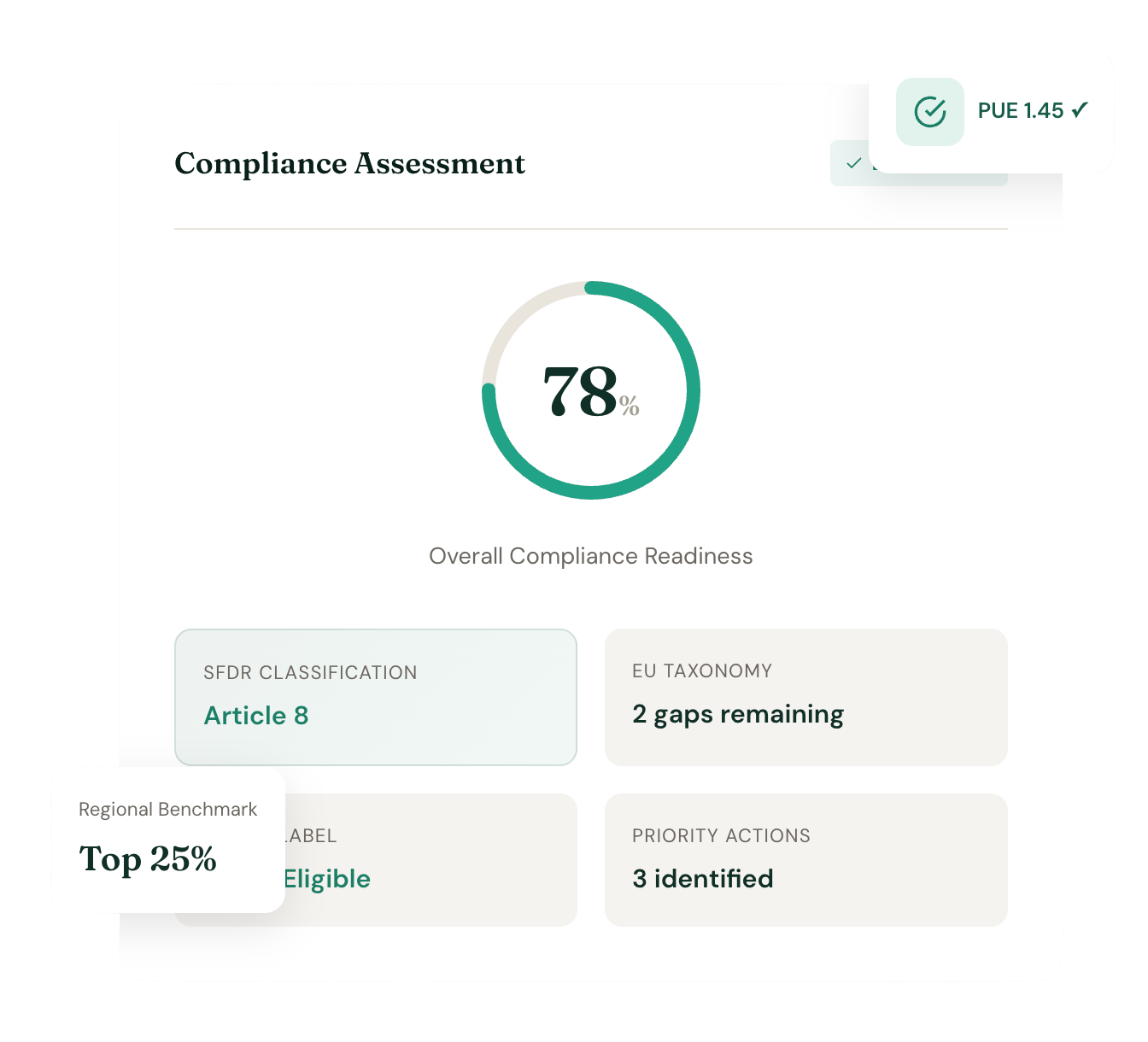
A developer who has completed our engagement arrives with a Sustainability Readiness Report structured for institutional due diligence. It contains a complete EU Taxonomy Activity 8.1 assessment with location-specific calibration documented throughout, quantified SFDR PAI indicator data mapped to actual project performance, governance evidence at the level of specificity Article 8 and 9 classification requires, and a minimum social safeguards assessment grounded in the specific legal context of the facility's country of operation.
Where gaps remain, they are disclosed precisely and addressed through a specific improvement roadmap. The developer arrives knowing what you will find — having already resolved what can be resolved, and documented a credible path for what remains.
Metrics without context
A PUE of 1.4 means something different in a temperate Nordic climate than in a high-ambient-temperature environment. Without climate zone calibration, the number does not map to an EU Taxonomy threshold.
Wrong baseline assumptions
Carbon intensity calculated against the wrong national grid emission factor, or water stress scored without reference to WRI Aqueduct classifications, produces DNSH assessments that do not hold up under scrutiny.
Framework mismatch
A developer who has prepared for EU Taxonomy review but not for SFDR PAI disclosure — or vice versa — leaves gaps that surface mid-process and require either remediation under time pressure or a pricing concession.
Who is Perennity Bridge for?
How the engagement works?
We take the developer's project data — location, capacity, cooling design, energy sources, governance structure — and run it through a compliance assessment framework built for data centre infrastructure globally. We map the facility against EU Taxonomy Activity 8.1 Technical Screening Criteria, SFDR Article 8 and 9 eligibility requirements, UK SDR classification criteria, and applicable DFI standards, with regional calibration applied throughout for local climate conditions, water stress classification, and grid carbon intensity.
Phase 1: Baseline Assessment
Structured data collection across energy performance, renewable sourcing, water use, governance, and project context. Maps the project against EU Taxonomy Activity 8.1, full DNSH requirements, and SFDR Article 8 and 9 classifications. Produces a clear gap analysis with evidence requirements for each gap. Approximately one working week.
Phase 2: Documentation Build
Four documents produced: EU Taxonomy Activity 8.1 assessment with location-specific calibration; quantified SFDR PAI indicator mapping from actual project data; governance and reporting evidence pack; and minimum social safeguards assessment for the facility's country of operation.
Phase 3: Deliverables
Sustainability Readiness Report — structured for credit committee and investment committee review, designed to function as the primary due diligence input. Improvement Roadmap — prioritised action plan for any remaining gaps, with specific regulatory references and realistic implementation timelines.
Purpose-Built vs. Generic Tools
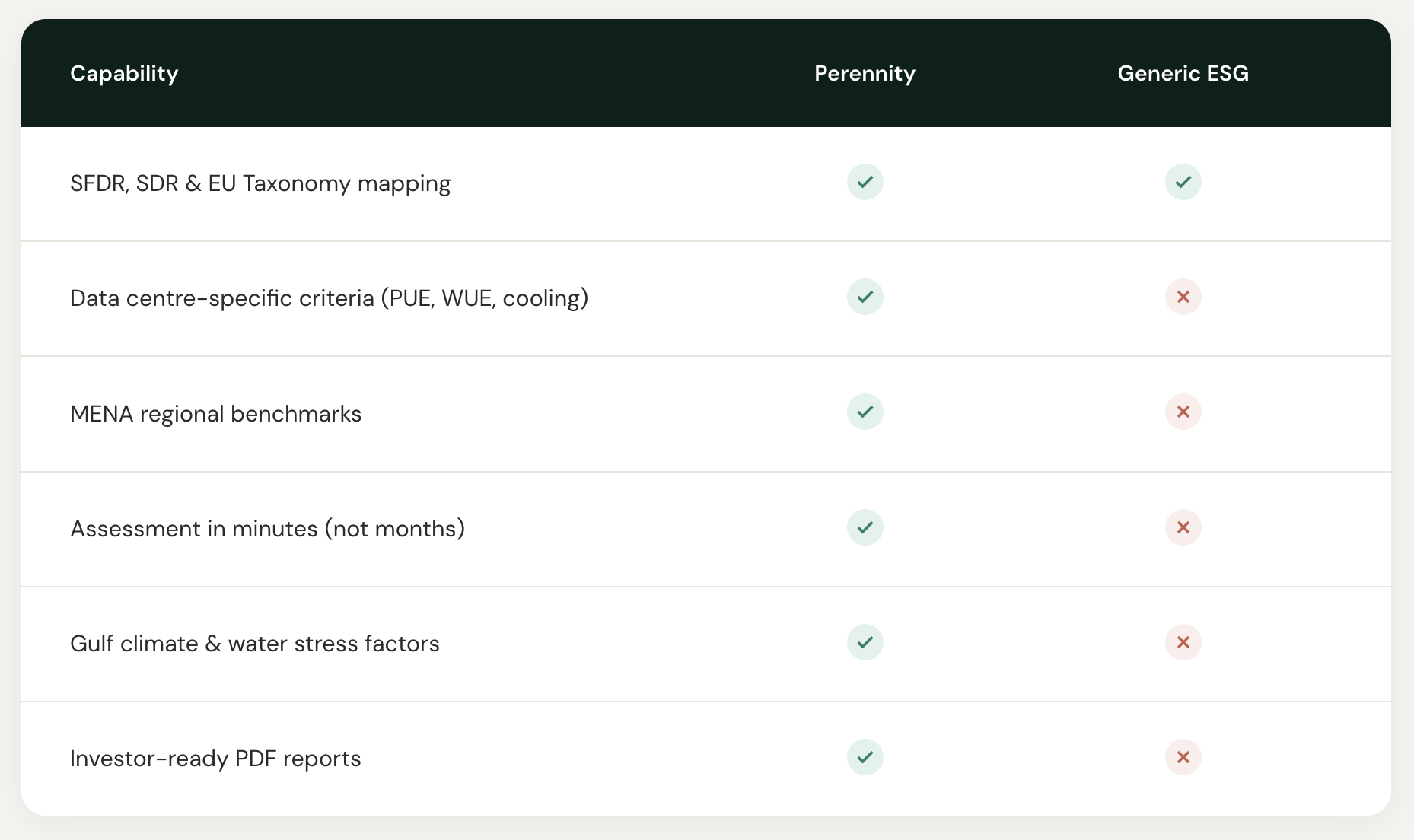
Complete framework mapping, built from primary sources
Perennity Bridge was founded by specialists in sustainable finance and global data centre infrastructure. Our team combines deep working knowledge of EU Taxonomy, SFDR, and UK SDR with direct experience of how these frameworks apply — and where they require calibration — to data centre assets operating across different climate conditions, grid environments, and capital structures.
EU SFDR
Article 6/8/9 + PAI indicators
UK SDR
all four sustainability labels
EU Taxonomy
Activity 8.1 + DNSH criteria
Target Initatives
DEWA, Saudi Green Initiative, QFC requirements.
What you need to know about data center investment and lending?
What is a data center advisory and financing firm?
Data center projects attract investment from private equity firms, infrastructure funds, sovereign wealth funds, and pension funds. Hyperscale technology companies also invest directly in data center infrastructure, creating strong demand and driving long-term capital flows into the sector.
How do you find data center investors?
Finding data center investors typically involves working with advisors who have established relationships with institutional capital providers. Direct outreach is possible, but most investors require structured opportunities with clear financial models, making professional positioning and introductions critical to securing investment.
What returns do data center investors expect?
Data center investors expect returns that vary based on risk, with core infrastructure assets delivering stable yields and development projects offering higher returns. Institutional investors are particularly attracted to predictable cash flows supported by long-term contracts and strong demand from hyperscale customers.
How do lenders assess data center financing risk?
Lenders assess data center risk based on power availability, tenant agreements, location, development stage, and long-term demand. Projects with secured tenants, strong infrastructure fundamentals, and scalable capacity are viewed as lower risk and more attractive for financing.
What types of debt financing are available for data centers?
Debt financing options include senior loans, mezzanine financing, and structured project finance. The appropriate structure depends on project maturity and risk profile, with institutional lenders favouring well-structured data centers that demonstrate long-term stability and clear revenue generation.
What do data center investors look for in early-stage projects?
In early-stage data center projects, investors look for strong fundamentals such as access to power, a scalable design, and a credible development team. Clear demand indicators, including proximity to hyperscale customers or key markets, also play a critical role in securing early investment.
Are data centers considered infrastructure investments?
Yes, data centers are increasingly classified as critical infrastructure due to their essential role in supporting digital economies. This classification has attracted significant institutional capital, as data centers offer stable, long-term returns and strong demand driven by global data consumption.
What makes a data center attractive to institutional investors?
Institutional investors are attracted to data centers that offer reliable power, strong connectivity, and strategic location advantages. Long-term tenant agreements, particularly with hyperscale operators, enhance investment appeal by providing predictable revenue and reducing overall project risk.
Can smaller developers access data center investment capital?
Smaller developers can access data center investment capital through joint ventures, partnerships, or advisory-led introductions. Strong project fundamentals, a clear execution strategy, and alignment with investor expectations are essential to securing institutional funding.
How do hyperscalers influence data center investment strategies?
Hyperscalers significantly influence data center investment strategies by driving demand for large-scale capacity and offering long-term contracts that reduce risk. Their involvement increases project bankability and attracts institutional investors seeking stable, infrastructure-like returns.
Perennity Bridge copyright © All Rights Reserved 2026