
Data Center Advisory Agency
From gap analysis to investor-ready Datacenter documentation
You are a data center developer approaching a capital raise or refinancing that involves Institutional investors or green lenders. Someone in that process has asked for sustainability documentation — EU Taxonomy alignment, SFDR PAI data, Article 8 or 9 classification evidence — and what you currently have is not structured to answer those questions directly.
That translation is what we provide.
Start with a free Capital Alignment Review — your gap analysis delivered in minutes. No charge. No credit card required.
$270B+
Global DC investment announced in 2025
$530B
Green bonds forecast for 2026
6
Regulatory frameworks covered
Institutional investors now require sustainability compliance before capital is committed — regardless of where your project sits
Most capital markets now operate under sustainability frameworks — the EU Taxonomy, SFDR, and UK SDR — that require verifiable, structured evidence of environmental performance before capital can be deployed. A data centre in Singapore, Lagos, Frankfurt, or Riyadh does not map onto these frameworks automatically. The performance may be there. The documentation almost never is.
The result is a transaction bottleneck that costs developers time, pricing leverage, and in some cases the deal itself. Sustainability gaps found during live lender diligence do not get fixed quickly. They get priced in, or they send the developer away to commission a months-long consultant engagement that costs six figures and produces a report that still is not in the right format.
Months of manual assessment
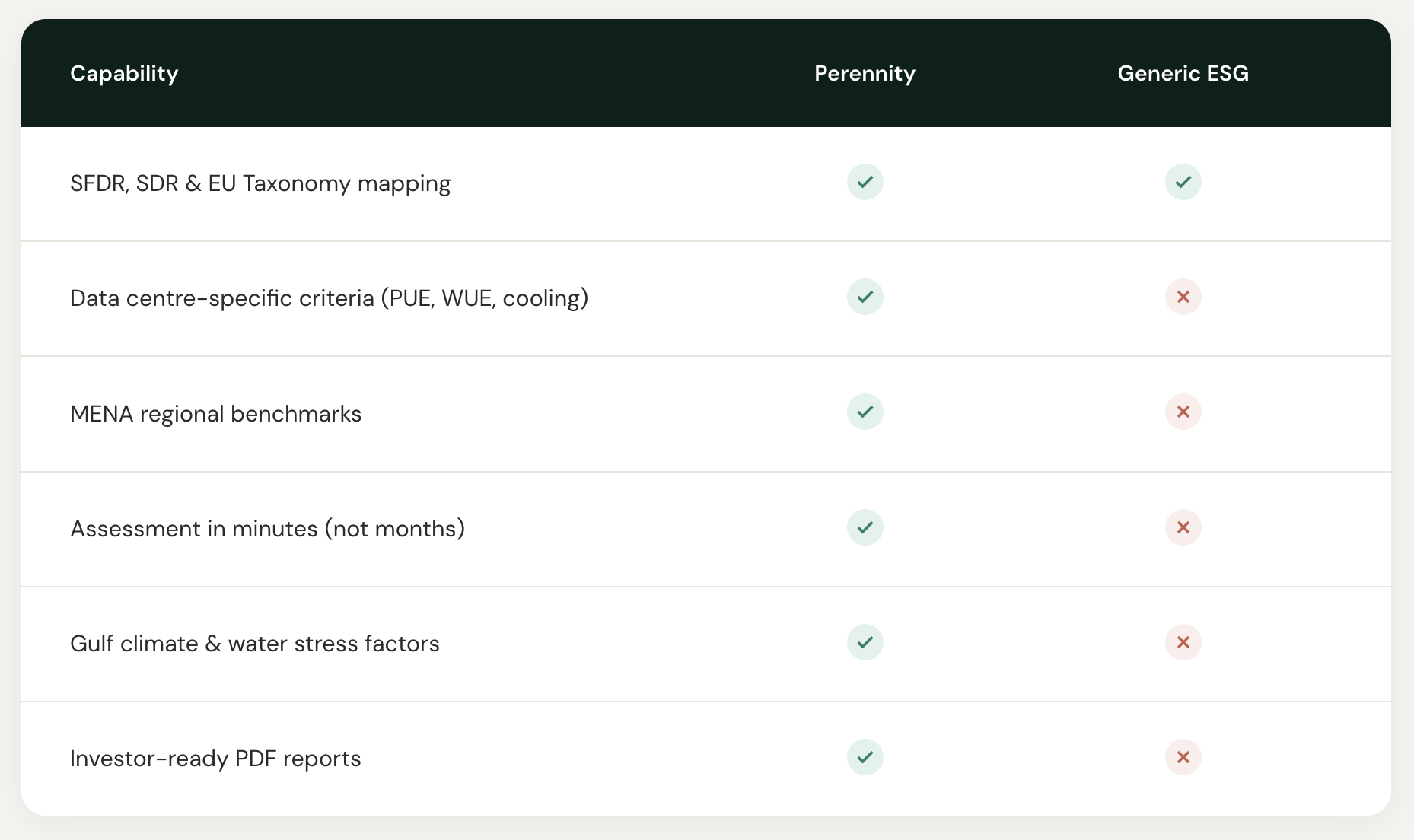
Traditional consultants take 8 to 12 weeks and charge £50K to £150K for compliance gap analysis that is outdated by the time it is delivered.
No location-specific tools
Generic ESG platforms do not account for local climate conditions, regional water stress classifications, or the carbon intensity of the grid your facility depends on.
Regulatory Complexity
SFDR Article 8/9, UK SDR labels, EU Taxonomy Activity 8.1 — investors expect you to know which applies to your project and why.
How it works
From Assessment to Investor-Ready in Minutes
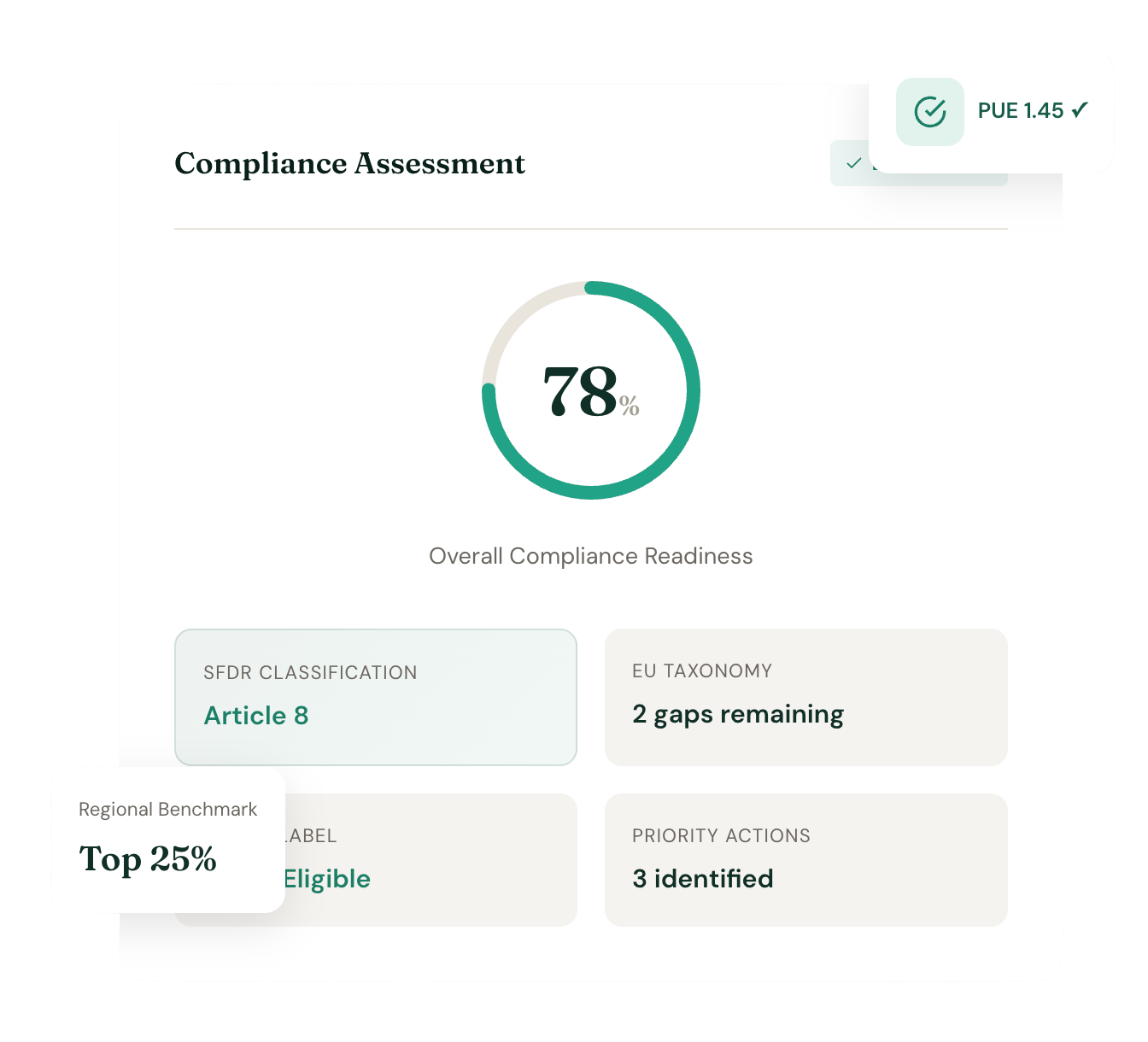
We take your data center project data — location, capacity, cooling design, energy sources, governance structure — and run it through a compliance assessment framework built for data centre infrastructure globally. We map your facility against EU Taxonomy Activity 8.1 Technical Screening Criteria, SFDR Article 8 and 9 eligibility requirements, UK SDR classification criteria, and applicable DFI standards, with regional calibration applied throughout for local climate conditions, water stress classifications, and grid carbon intensity.
Run the free assessment now and receive your gap analysis in minutes — a precise, project-specific picture of where your facility stands against EU and UK capital market requirements, and what needs to change.
Baseline assessment
We collect structured data across five areas: energy performance, renewable sourcing and carbon intensity, water use and environmental safeguards, governance and reporting controls, and project context. The process takes around one working week. We then map the project against EU Taxonomy Activity 8.1 criteria, full DNSH requirements across six environmental objectives, and SFDR Article 8 and 9 classifications — producing a clear gap analysis of compliance status and the evidence required to close each gap.


Documentation build
Working from the gap analysis, we produce four documents: an EU Taxonomy Activity 8.1 assessment with location-specific calibration applied and justified throughout; a quantified SFDR PAI indicator mapping drawn from your actual project data; a governance and reporting evidence pack covering board-level oversight, data controls, and management safeguards; and a minimum social safeguards assessment grounded in the specific legal and operational context of your facility's country of operation.
Deliverables
Two final documents. The Sustainability Readiness Report presents your facility's sustainability position in a format built for credit committee and investment committee review — designed to function as the primary due diligence input, not the starting point for further questions. The Improvement Roadmap is a prioritised action plan for any remaining gaps: what needs to change, why it matters to your target classification, and what the realistic implementation timeline is.

Built for Data Center Developers, Investors
Data center developers globally who are planning or actively raising EU or UK capital — including projects across the Gulf, Africa, Southeast Asia, Europe, and the Americas. Infrastructure investors and operators who need to evidence sustainability performance for refinancing, portfolio reporting, or lender covenant compliance.
Multi-Framework Mapping
A single assessment maps simultaneously to SFDR Article 6/8/9, all four UK SDR labels and EU Taxonomy Activity 8.1.
Investor-Ready Reports
Generate professional PDF reports designed for green finance due diligence, with executive summaries, technical appendices, and a citation trail to primary regulation.
Regulatory Intelligence
Stay current with automated tracking of SFDR, SDR, and EU Taxonomy updates — including the 2026 Taxonomy review cycle.
Global Benchmarks
Compare your metrics against facilities across 35+ jurisdictions. See exactly where you stand on PUE, water efficiency, and renewable energy for your specific location and climate zone.
Gap Analysis Engine
Automatically identify compliance gaps with severity ratings and prioritised remediation actions, including the specific clause in the relevant regulation that is not yet met.
Expert Upgrade Path
Move seamlessly from the free tool into a consultant-led gap remediation and investor documentation engagement with Perennity Bridge directly.
Purpose-Built vs. Generic Tools
Complete framework mapping, built from primary sources
Perennity Bridge was founded by specialists in sustainable finance and global data centre infrastructure. Our team combines deep working knowledge of EU Taxonomy, SFDR, and UK SDR with direct experience of how these frameworks apply — and where they require calibration — to data centre assets operating across different climate conditions, grid environments, and capital structures. We built the assessment framework because the tool we needed did not exist.
EU SFDR
Article 6/8/9 + PAI indicators
UK SDR
ll four sustainability labels
EU Taxonomy
Activity 8.1 + DNSH criteria
Target innovative
DEWA, Saudi Green Initiative, QFC requirements.
What you need to know about datacenter advisory?
What does a data center advisory agency do?
A data center advisory agency provides strategic, financial, and operational guidance across the full lifecycle of a data center project. This includes site selection, power strategy, capital structuring, and investor positioning, ensuring the project is both technically viable and commercially attractive to lenders, investors, and hyperscale customers.
How much does a data center advisory agency cost?
The cost of a data center advisory agency varies depending on project scope, typically ranging from fixed fees for feasibility work to success-based fees tied to capital raising. For large-scale developments, advisory fees are often a small percentage of total project value, reflecting the significant impact on financing outcomes and investor alignment.
When should I hire a data center advisory agency?
A data center advisory agency should be engaged at the earliest possible stage, ideally before land acquisition or financing discussions begin. Early involvement ensures optimal decisions around power availability, site selection, and capital structure, significantly increasing the likelihood of securing funding and achieving successful project delivery.
What services are included in data center advisory services?
Data center advisory services include feasibility analysis, financial modelling, funding strategy, investor introductions, and regulatory guidance. Advisors may also support due diligence, negotiations, and operational planning, ensuring the data center project is fully aligned with market expectations and investor requirements.
How does a data center advisory agency help raise capital?
A data center advisory agency helps raise capital by structuring investment propositions, building financial models, and connecting clients with institutional investors and lenders. This includes private equity firms, infrastructure funds, and debt providers, ensuring the project is positioned effectively to secure funding at competitive terms.
What is the difference between a data center consultant and a data center advisory agency?
A data center consultant typically focuses on technical or operational aspects, such as design or efficiency, while a data center advisory agency takes a broader commercial role. Advisory services integrate financing, investment strategy, and market positioning, ensuring the project is structured to attract capital and achieve long-term success.
Do data center advisory agencies work with investors as well as developers?
Yes, data center advisory agencies work with both developers and investors, providing insights that align project execution with capital expectations. This dual perspective allows advisors to bridge the gap between development and investment, creating more efficient and successful transactions.
How long does a data center advisory engagement last?
The duration of a data center advisory engagement varies depending on project complexity. Early-stage feasibility may take a few weeks, while full lifecycle advisory—from concept to financing and execution—can last 12 to 24 months, particularly for large-scale or multi-phase data center developments.
Why do data center projects fail without proper advisory support?
Many data center projects fail due to misalignment between power availability, financing structure, and market demand. Without proper advisory support, developers often secure land or begin development before confirming capital viability, leading to delays, funding gaps, or projects that are not considered bankable by investors.
Datacenter Compliance Assessment Tool
Input your project data and receive a gap analysis in minutes — a precise, project-specific picture of where your facility stands against EU Taxonomy Activity 8.1 Technical Screening Criteria, SFDR Article 8 and 9 classification criteria, and UK SDR requirements, with calibration applied for your project's location, climate zone, and capital source.
The gap analysis tells you what you have, what you are missing, and how material each gap is to your target investors. For many developers, this is the first time they have seen their project evaluated against these frameworks with any precision.
Free assessment • No credit card required • Results in 5 minutes
Perennity Bridge copyright © All Rights Reserved 2026