
Sustainable Data Center Financing
EU Taxonomy Datacenter Requirements
Access to European capital increasingly depends on demonstrable EU Taxonomy alignment. If your data centre cannot evidence compliance, it may be excluded from green funds, sustainability-linked finance, and Article 8 or Article 9 investment mandates.
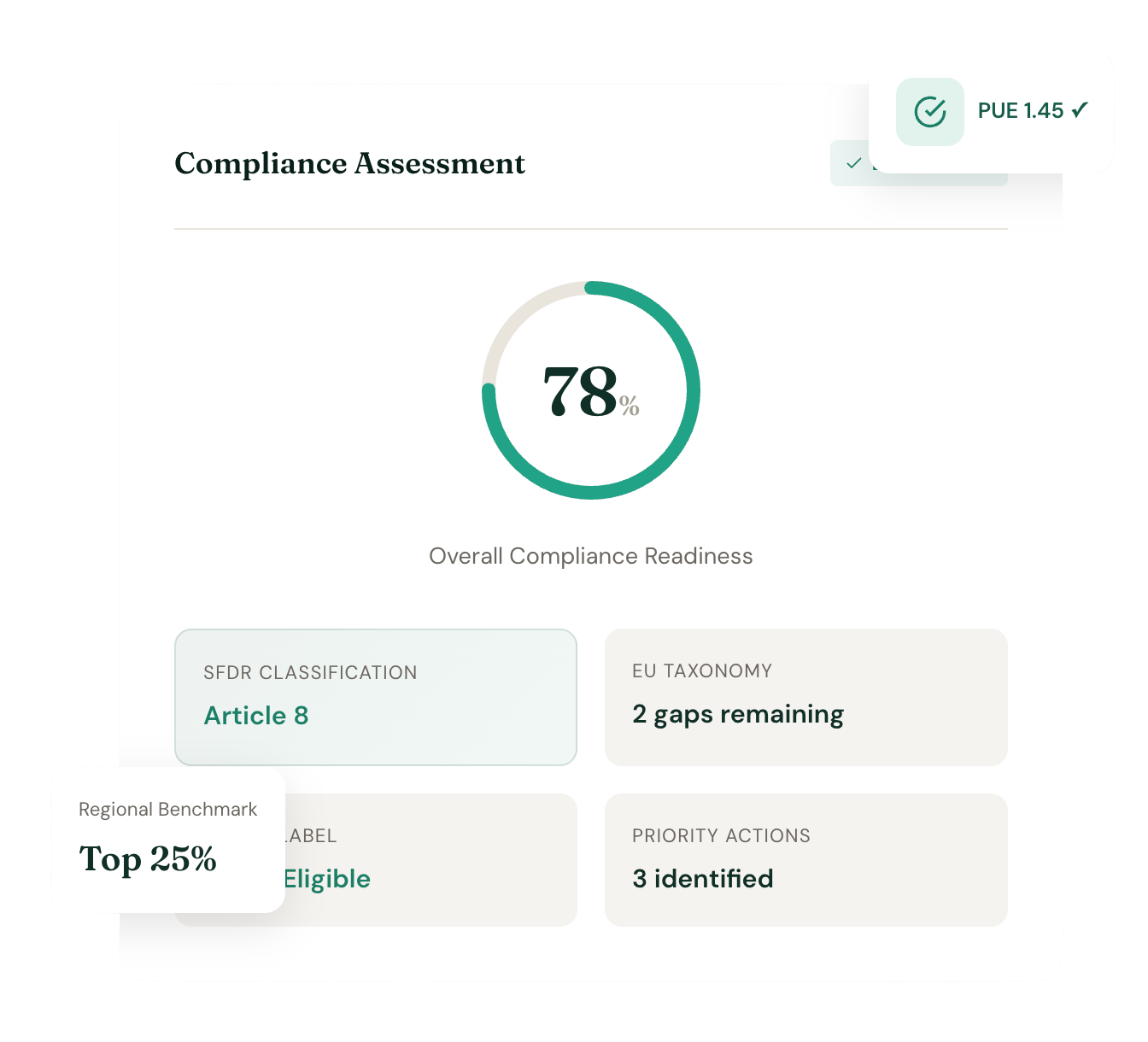
Our EU Taxonomy Data Center Assessment delivers:
Our EU Taxonomy Data Center Assessment provides a structured review of your facility’s alignment with Climate Mitigation criteria and environmental safeguards. We identify compliance gaps, clarify eligibility status, and translate operational data into investor-ready documentation for sustainable finance and due diligence.
Eligibility Screening (Article 8.1)
We assess whether your facility qualifies under EU Taxonomy Climate Mitigation (Activity 8.1). This includes reviewing technical screening thresholds, energy efficiency criteria, and operational scope to determine eligibility status and identify clear alignment or exclusion risks.
PUE & Carbon Performance Gap
We evaluate current PUE performance, renewable energy sourcing, and operational carbon intensity against EU thresholds. The analysis highlights compliance gaps, quantifies risk exposure, and defines the technical improvements required to achieve or strengthen Taxonomy alignment.
DNSH Compliance Review
We conduct a structured Do No Significant Harm review covering water usage, circular economy practices, pollution prevention, and biodiversity safeguards. This identifies documentation gaps, operational weaknesses, and regulatory risks that may prevent full Taxonomy alignment.
Governance & Disclosure Readiness
We assess board oversight, climate risk management, reporting controls, and sustainability disclosures. The review ensures your organisation can evidence compliance clearly and consistently to investors, auditors, and financial counterparties.
Investor-Ready Summary Report
We deliver a concise, defensible summary translating operational metrics into a clear alignment position. The report supports Article 8 or Article 9 investment classification, strengthens due diligence outcomes, and improves access to sustainable finance.
What Is the EU Taxonomy?
The EU Taxonomy Regulation is a legally binding framework designed to direct capital toward environmentally sustainable activities. It applies directly to financial market participants under the Sustainable Finance Disclosure Regulation (SFDR) and increasingly interacts with corporate reporting under the Corporate Sustainability Reporting Directive.
To qualify as Taxonomy-aligned, an activity must:
Climate Change Mitigation: Activity 8.1
Under Activity 8.1, data processing and hosting facilities must demonstrate high energy efficiency and alignment with EU decarbonisation goals.
Facilities must show that energy efficiency is embedded into design and operations. This includes cooling optimisation, monitoring systems, and continuous improvement processes. Simply purchasing renewable certificates without demonstrating operational efficiency may not be sufficient for alignment.
Do No Significant Harm (DNSH) Criteria
Our EU Taxonomy Data Center Assessment provides a structured review of your facility’s alignment with Climate Mitigation criteria and environmental safeguards. We identify compliance gaps, clarify eligibility status, and translate operational data into investor-ready documentation for sustainable finance and due diligence.
Water Protection
Datacentre Operators must manage water responsibly, especially in high water-stress regions. Evidence may include Water Usage Effectiveness (WUE) tracking, recycling initiatives, and alternative water sourcing.
Circular Economy
Hardware lifecycle management is critical. This includes documented e-waste processes, refurbishment or reuse programmes, and responsible procurement policies. Disposal of datacenter equiptment must meet recognised environmental standards.
Pollution monitoring
Backup generation, refrigerants, and operational emissions must comply with EU environmental rules. Datacentre Facilities should demonstrate monitoring and mitigation of air, soil, and water pollution risks.
Biodiversity and Ecosystems
Datacentre Site development must avoid harm to habitats and protected areas. This includes impact assessments, responsible land use, mitigation measures, and ongoing monitoring to ensure compliance with EU biodiversity rules.
What you need to know about datacenter financing?
What is sustainable data center financing?
Sustainable data center financing refers to funding structures designed to support low-carbon, energy-efficient data center infrastructure. This includes green loans, sustainability-linked debt, and ESG-aligned capital strategies that prioritise renewable energy usage, efficient cooling systems, and reduced emissions. These financing models are increasingly required by institutional investors seeking long-term, regulation-compliant infrastructure assets.
How much does data center financing typically cost?
The cost of data center financing depends on project scale, risk profile, and structure, but typically ranges between 4% and 12% for debt, with equity expectations significantly higher. Sustainable data centers with strong ESG credentials often achieve more favourable pricing due to increased investor demand and reduced long-term risk associated with energy and regulatory exposure.
What are the requirements to secure data center financing?
To secure data center financing, projects must demonstrate reliable power access, a strong location strategy, experienced operators, and a clear commercial model. Lenders and investors also expect detailed financial models, pre-leasing or demand visibility, and increasingly, a defined sustainability strategy aligned with ESG frameworks and energy efficiency standards.
What funding options are available for a sustainable data center?
Sustainable data center projects can access green bonds, project finance, infrastructure funds, private equity, and sustainability-linked loans. The choice of funding depends on project maturity and scale, with hyperscale-ready developments typically attracting institutional capital, while earlier-stage projects may require blended financing or strategic partnerships.
Can renewable energy improve data center financing terms?
Yes, integrating renewable energy significantly improves data center financing terms. Projects with secured renewable power—such as long-term PPAs or on-site generation—are viewed as lower risk by lenders and investors. This often results in reduced cost of capital, improved debt availability, and stronger alignment with ESG investment mandates.
How do investors assess sustainability in a data center?
Investors assess data center sustainability using metrics such as Power Usage Effectiveness (PUE), carbon intensity, cooling efficiency, and energy sourcing strategy. They also evaluate long-term ESG alignment, including regulatory compliance and decarbonisation plans, as these factors directly impact both asset valuation and long-term investment risk.
What is a green loan for a data center project?
A green loan for a data center is a financing instrument specifically used to fund environmentally sustainable infrastructure. These loans require measurable environmental outcomes, such as improved energy efficiency or reduced emissions, and ongoing reporting. For data centers, this typically includes metrics like PUE performance and renewable energy utilisation.
Is sustainable data center financing cheaper than traditional financing?
Sustainable data center financing is often more competitive over time due to increased demand from ESG-focused investors. While structuring may initially be more complex, projects that meet sustainability criteria typically benefit from lower interest rates, broader access to capital, and improved long-term financial performance.
How do you structure financing for a large-scale data center project?
Financing for large-scale data center projects is typically structured using a mix of senior debt, equity investment, and sometimes mezzanine capital. The structure depends on project size, pre-leasing status, and risk profile, with institutional investors favouring scalable developments backed by strong power infrastructure and long-term demand.
What makes a data center project attractive to institutional investors?
Institutional investors are attracted to data centers with strong fundamentals, including access to power, connectivity, strategic location, and long-term tenant demand. Projects with hyperscale customers, scalable design, and ESG alignment are particularly attractive, as they offer stable cash flows and long-term growth potential.
Preparing for the Future
Regulation and investor expectations will continue to tighten. Facilities that embed monitoring, documentation, and governance controls today will be better positioned for evolving EU Taxonomy requirements. Alignment is not just about current thresholds - it future-proofs infrastructure for expansion, refinancing, and institutional capital, ensuring readiness before due diligence begins.
Free assessment • No credit card required • Results in 5 minutes
Perennity Bridge copyright © All Rights Reserved 2026